
Iraq Cardiology Community updates
What moves our field forward.
News, education, clinical updates, and shared work that strengthen cardiovascular care across Iraq.
New ESC 2026 guideline: cardiovascular disease and chronic kidney disease
The European Society of Cardiology has published a new 2026 guideline focused on the intersection of cardiovascular disease and chronic kidney disease. Explore the official publication from the DOI link below.
Read update
Baghdad Teaching Hospital field record: a multidisciplinary Carvedilol teaching session
Dr. Farouq Hameed, Clinical Cardiology Fellow, led a Baghdad Teaching Hospital session on indication-specific Carvedilol use and clinical stability, supervised by Prof. Hasan Ali Farhan and attended by fellows across four cardiovascular disciplines.
Read updateHFpEF in 2026: diagnose the syndrome, search for mimics, treat the whole phenotype
A 2026 ACC expert pathway frames HFpEF as a multisystem syndrome: diagnose thoughtfully, look for cardiac and noncardiac mimics, and address comorbidities alongside evidence-based therapy.
Read update
When a Coronary Stent Fails: Can Stentectomy Offer a Way Forward?
A new review suggests that catheter-based removal of a fully deployed coronary stent may be feasible in carefully selected cases of complex stent failure — but only within a highly specialized, imaging-led strategy.
Read updateQuick Hit: AF care quality moves from a checklist to a care pathway
The 2026 AHA/ACC atrial-fibrillation performance and quality measures put initial evaluation, stroke-risk documentation, prevention, equity, and shared decisions into one visible care-quality framework.
Read updateQuick Hit: Lp(a) enters the standard lipid conversation
The 2026 ACC/AHA dyslipidemia guideline recommends measuring lipoprotein(a) at least once in adults as part of ASCVD risk assessment—an update that broadens the prevention conversation beyond LDL-C alone.
Read updateFrom siloed risks to one pathway: the 2026 cardiovascular-kidney-metabolic guideline
A new multisociety guideline connects obesity, diabetes, chronic kidney disease, and cardiovascular disease in one staged framework. For cardiology teams, the key idea is coordinated risk assessment and care—not a one-size-fits-all prescription list.
Read updateQuick Hit: A new shared language for heart failure
The 2026 AHA/ACC/ESC/WHF consensus reframes heart-failure classification around reduced, preserved, and improved ejection fraction, while giving greater attention to causes and clinical trajectories. It standardizes language; it is not a treatment guideline.
Read updateComplex bifurcation PCI: DKCRUSH VIII puts IVUS optimization in focus
A randomized trial in complex coronary bifurcation PCI found lower one-year target-vessel failure with IVUS guidance when operators achieved prespecified optimization targets. The result is clinically important but applies to a highly selected DK-crush setting—not every bifurcation PCI.
Read update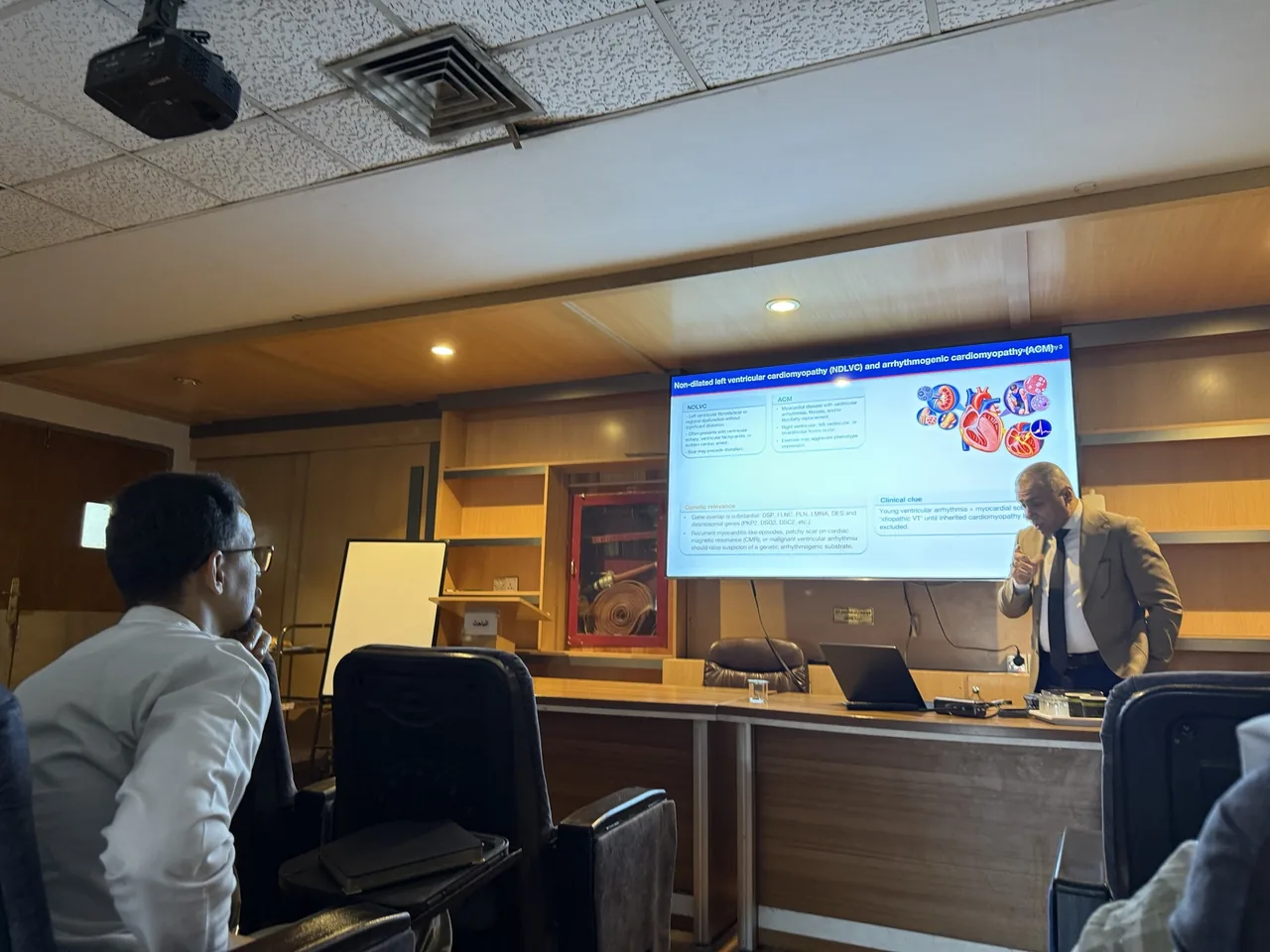
Cardiac Genetics at Baghdad Teaching Hospital: From Clinical Clues to Genetic Diagnosis
A same-day Clinical Education Field Note from Baghdad Teaching Hospital, where Dr. Mohammed Ghanem led a session on recognising cardiovascular clues that may inform genetic assessment.
Read update
Left Atrial Strain in ATTR-CM: What the HELIOS-B Secondary Analysis Adds
A secondary HELIOS-B analysis links impaired left atrial strain with worse outcomes in transthyretin amyloid cardiomyopathy and reports less worsening of strain with vutrisiran at 30 months.
Read update
Finerenone in Cardio-Kidney-Metabolic Syndrome With Cancer History: FINE-HEART Insights
A large pooled post hoc analysis found that cancer history marked higher risk in cardio-kidney-metabolic syndrome, while finerenone benefits were consistent regardless of cancer history.
Read updateMavacamten in Obstructive HCM: A US FDA Regulatory Reference From 2022
An FDA reference note on the 2022 US approval of mavacamten for symptomatic NYHA class II–III obstructive hypertrophic cardiomyopathy, including the monitoring and REMS requirements highlighted by the regulator.
Read updateSubclinical Coronary Atherosclerosis and Myocardial Infarction Risk: Evidence From a Danish CT Cohort
A Danish population cohort found less subclinical coronary atherosclerosis in women, while obstructive disease on CT was associated with higher myocardial infarction risk in both women and men.
Read update